
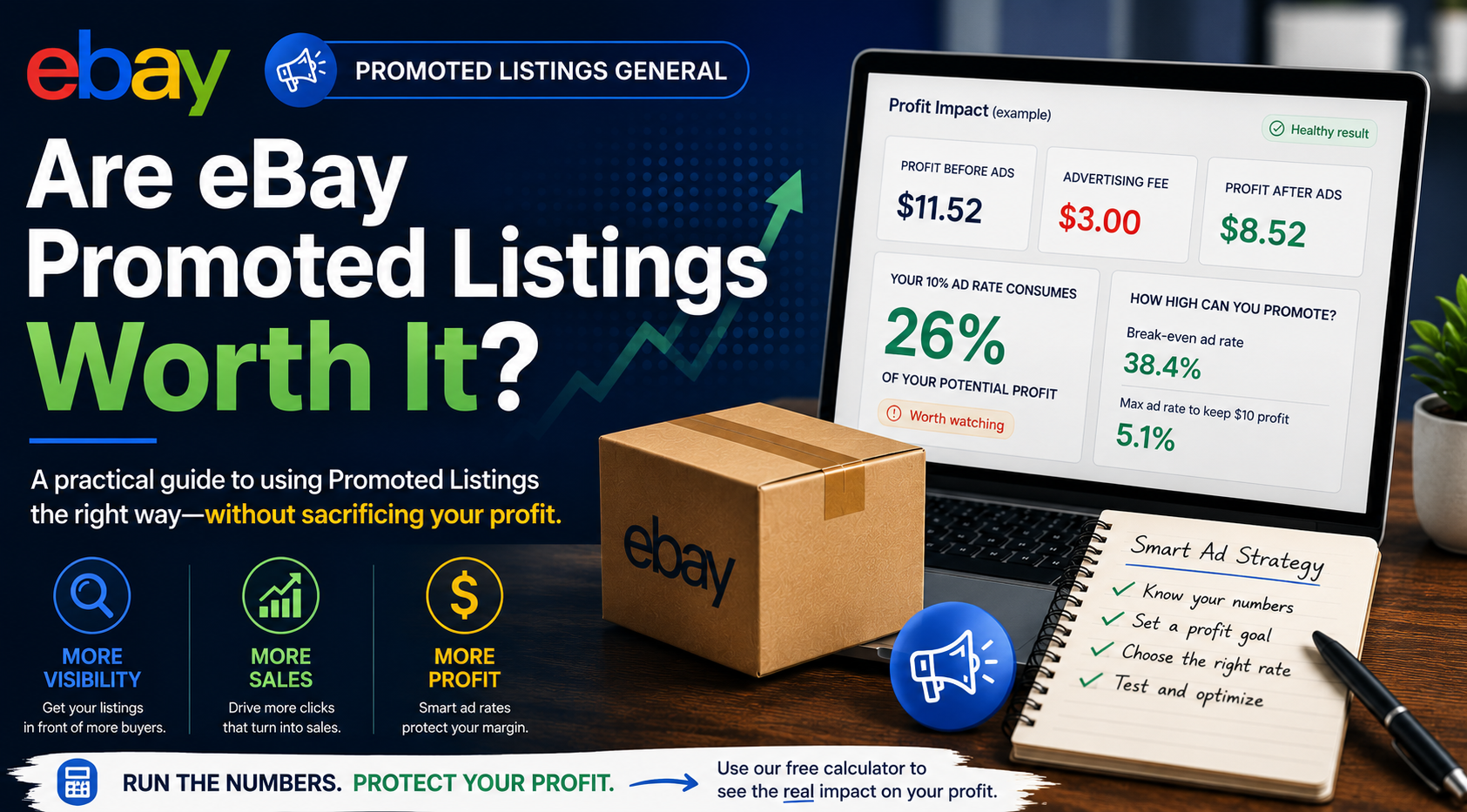
Promoted Listings can be an effective way to get more eyes on your eBay listings.
But more visibility isn't automatically more profit.
The important question isn't simply:
Did advertising generate a sale?
It's:
Was that sale still worth making after the advertising fee?
That distinction becomes especially important on lower-margin products, where a seemingly reasonable ad rate can consume a surprisingly large portion of the profit.
How eBay Promoted Listings General Works
With a General campaign, you choose an ad rate—the percentage eBay can charge when an eligible promoted sale occurs.
Unlike a traditional pay-per-click campaign, General campaigns charge when the promoted item sells following a qualifying ad click.
That makes them relatively easy to experiment with: you're tying the advertising expense to a completed sale rather than simply buying clicks.
But there's an important detail.
The percentage isn't based on your profit. It's based on the applicable total amount of the sale, which can include the item price, shipping charged to the buyer, and sales tax.
So a 10% promoted listing rate doesn't mean you're giving up 10% of your profit. It can be considerably more.
A 10% Ad Rate Can Cost Much More Than 10% of Your Profit
Imagine an item sells for $30.
After the item's cost, shipping, packaging, and normal eBay selling fees, suppose you would have earned $12 before advertising.
A $3 promoted listing fee would reduce that profit to $9.
The advertising rate may have been 10%, but:
You gave up 25% of your potential profit.
That's the number worth watching.
Before deciding how aggressively to promote a listing, see what the ad rate actually does to your numbers.
Calculate your eBay Promoted Listing profit →
When Promoted Listings Can Make Sense
Promoting a listing can make sense when additional visibility creates enough additional profitable sales to justify the cost.
You're Competing in a Crowded Category
A good listing doesn't help much if buyers never see it. Advertising may be worthwhile when you're competing against many similar listings and additional placement gives your product a meaningful visibility boost.
The Product Has Healthy Margins
A product earning $25 before advertising has considerably more room for ad spend than one earning $4.
This is why using the same promoted rate across every product can be dangerous. The question isn't “What ad rate should I use for my eBay store?” It's “What ad rate can this particular product afford?”
You Want to Test a Listing
Advertising can also be useful as an experiment. If you believe a listing converts well once buyers see it, promotion can help put that assumption to the test.
Watch what happens to:
- Impressions
- Clicks
- Sales
- Advertising cost
- Actual profit
Then decide whether the additional exposure is paying for itself.
You're Protecting a Specific Profit Target
Suppose you want to make at least $10 on every sale. Instead of choosing an ad rate first, work backward:
How much advertising can this product afford while still leaving me $10?
That's a much safer way to think about advertising.
When You Should Be Careful
Promoted Listings aren't automatically bad for lower-priced or lower-margin products. But those products have less room for error.
Thin Margins
If you're only making a few dollars before advertising, even a modest promoted rate can consume a large percentage of your profit. Run the numbers before increasing the rate.
Free Shipping
Free shipping isn't actually free. If you're absorbing postage, include that expense when deciding how much advertising the product can support.
Otherwise, it's easy to look at the selling price and overestimate how much room you have.
Automatically Following Suggested Rates
eBay provides suggested ad rates based on individual listings and marketplace conditions. Those recommendations can be useful information.
But eBay doesn't know what you paid for the item, how much it costs you to make, what you spend on packaging, or what profit you need from the sale.
A suggested rate can be reasonable from an advertising perspective while being unattractive from a profit perspective. Treat the suggested rate as a data point—not your profit target.
Fixed vs. Dynamic Ad Rates
General campaigns can use fixed or dynamic ad rates.
With a fixed rate, you choose the rate and it stays where you set it unless you change it.
With a dynamic strategy, the rate can adjust based on eBay's daily suggested rate.
Dynamic rates can reduce campaign maintenance, but they also make knowing your acceptable economics even more important. If your product can't comfortably support a higher advertising rate, understand that limit before letting advertising costs move automatically.
Don't Confuse General and Priority Campaigns
eBay also offers Priority campaigns, which use a different cost model.
| General | Priority |
|---|---|
| You pay an advertising fee when an eligible promoted sale occurs. | You pay for clicks. |
With a Priority campaign, advertising spend can occur whether or not those clicks eventually produce sales.
This article—and the Maker Forge calculator—focuses specifically on Promoted Listings General.
Start With Profit, Then Choose the Ad Rate
Instead of asking:
Should I promote this at 5%, 10%, or 15%?
Start with three numbers:
- What would I make without advertising?
- What's the minimum profit I want to keep?
- How much of the difference am I willing to spend to generate additional sales?
Now the advertising decision has a boundary.
Profit without ads: $14
Minimum profit you want: $10
Available advertising spend: $4
You can then determine what promoted rate fits inside that $4 budget. That's considerably more useful than choosing an arbitrary percentage.
The Number Worth Watching
Promoted Listings can work. The mistake is evaluating them solely by whether they generate sales.
A promoted sale that leaves you with healthy profit may be a great sale. A promoted sale that leaves almost nothing behind may simply be expensive revenue.
Before changing your eBay ad rate, know:
What does this product earn before advertising—and how much of that profit am I willing to give up for another sale?
Use the eBay Promoted Listings Profit Calculator to enter your selling price, product costs, shipping, and promoted rate. It estimates your profit before and after advertising, how much potential profit the ad consumes, and the ad rate at which the listing reaches break-even.
eBay fees, advertising programs, and attribution rules can change. This article discusses Promoted Listings General and is intended as a practical profitability guide, not official eBay documentation.