
Getting a first wholesale inquiry can feel like a major milestone. A retailer likes what you make, believes their customers will like it too, and asks a deceptively simple question:
What is your wholesale price?
Many makers begin with a familiar shortcut: take the retail price and divide it by two. If an item sells for $30, quote $15 wholesale.
That can be a useful market reference. But it is not the first question to answer.
Can you afford to make and sell the product at that price?
Start with the real cost to make the product
Wholesale is not simply a discount you offer a retailer. It is another selling situation your business needs to support.
Before choosing a price, account for the costs that actually go into one unit:
- Materials and components
- Packaging
- Hands-on production time
- Machine or equipment time
- Other recurring making costs
Suppose a product retails for $30 and a shop wants 20 units at $15 each. The order sounds substantial: $300 in revenue. But if each unit costs $12 to make, the order leaves only $3 per unit before any additional order-specific work.
| Per-unit view | Amount |
|---|---|
| Wholesale price | $15.00 |
| Cost to make | $12.00 |
| Profit per unit | $3.00 |
| Profit on 20 units | $60.00 |
The useful question is not whether $300 sounds exciting. It is whether $60 of gross profit is enough for the work, coordination, and cash tied up in producing 20 units.
Wholesale does not have to be half of retail
Retailers need room to earn money, but that does not mean every product can support a 50%-of-retail wholesale price. Your material costs, production time, and goals may not leave enough room.
| Product | |
|---|---|
| Retail price | $30.00 |
| Cost to make | $12.00 |
| Half-of-retail wholesale price | $15.00 |
| Profit per wholesale unit | $3.00 |
| Wholesale margin | 20% |
That outcome might work for one maker and be unacceptable for another. What matters is knowing the result before committing to the order.
If a product cannot support a traditional wholesale relationship at its current costs, that is not a pricing failure. It may be a signal to charge more, improve the production process, reduce costs, or reserve that product for direct sales.
Find the minimum price that supports your business goals
A more useful starting question is:
What is the lowest wholesale price I can charge while still meeting my Store Goals?
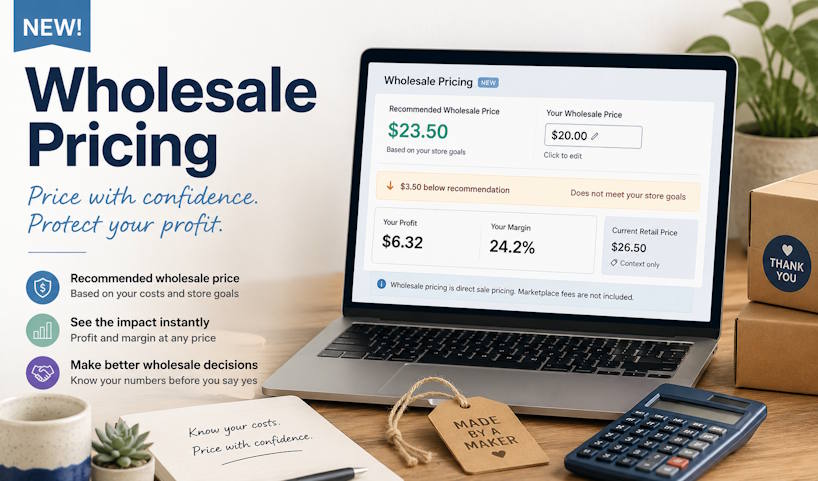
Maker Forge’s Wholesale Pricing uses the product costs and Store Goals you have already entered to calculate a recommended wholesale price. The recommendation is the minimum direct-sale price that satisfies those goals; marketplace fees are not automatically included.
For example, a recommended wholesale price of $23.50 may look close to a product’s $26.50 retail price. That is still valuable information. Maker Forge is not trying to predict what a retailer will pay or declare a universal wholesale percentage. It is showing the minimum price your business needs to earn under the goals you chose.
A recommendation is a guardrail, not a rule
You can still accept a lower offer. The point is to make that choice with the numbers visible.
If Maker Forge recommends $23.50 and a retailer offers $20, enter $20 as the wholesale price. You can see whether that price still meets your Store Goals and decide whether the tradeoff is worth it.
There may be good reasons to take a lower-margin order:
- A larger-than-usual order
- A retailer that reaches an important new audience
- A strategic relationship you want to build
- Excess production capacity you can use efficiently
Maker Forge does not prevent the choice. It makes the financial impact clear before you say yes.
A large order is not automatically a profitable order
Wholesale quantities make revenue grow quickly. An order for 50 products at $18 each produces $900 in revenue. But if each unit costs $14 to make, the underlying result is different:
| Order view | Amount |
|---|---|
| Revenue | $900.00 |
| Product cost | $700.00 |
| Gross profit | $200.00 |
That may be a worthwhile order—or it may not. The answer depends on the time, complexity, cash flow, and goals of your business. Revenue alone cannot answer it.
Some products are better direct-to-consumer products
Some handmade products have inexpensive materials, efficient production, and enough margin to support wholesale comfortably. Others depend on significant hands-on labor, specialized materials, or a price that only works in a direct sale.
That does not make the second product a bad product. It can be an excellent direct-to-consumer product and a poor fit for wholesale. Knowing the difference helps you avoid accepting a large order that creates a lot of work without creating enough income.
How Maker Forge helps with wholesale pricing
Wholesale Pricing in Maker Forge stays focused on the maker’s side of the decision:
- It recommends a minimum wholesale price based on the product’s real costs and your Store Goals.
- It lets you save a different wholesale price when you want to test or accept an offer.
- It shows whether the selected price meets your goals and flags a price that loses money.
- It treats wholesale as a direct-sale scenario, so marketplace fees are not assumed.
Maker Forge does not tell you what a retailer must accept. It gives you the numbers you need to decide what works for your business.
Price wholesale work with clarity
Wholesale can be a meaningful way to grow a handmade business. But a bigger order only helps when it supports the costs, time, and profit goals behind it.
Start with your true cost. Know the minimum price your business needs. Then decide whether the opportunity is worth accepting—with clarity instead of guesswork.