
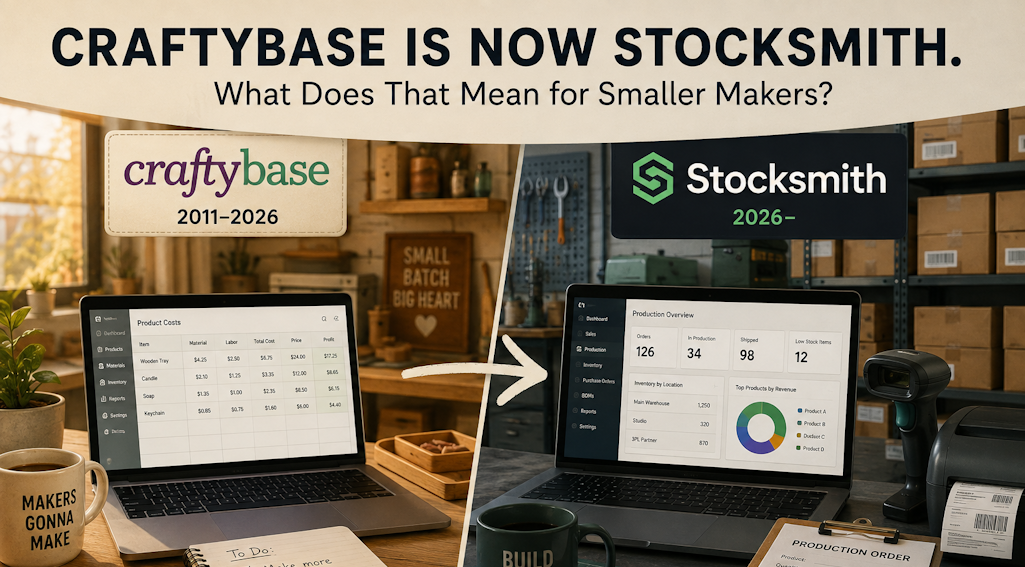
If you've searched for software to track the cost of handmade products, there's a good chance you've encountered Craftybase.
For fifteen years, Craftybase built tools for people who make and sell physical products. On July 1, 2026, Craftybase officially became Stocksmith.
The company is clear that this is a rebrand and not an acquisition. Existing accounts, data, pricing, plans, integrations, and features all remain in place. This rebrand reflects how Craftybase, and many of its customers, has grown.
Why Craftybase Became Stocksmith
Craftybase has been open about the reason for the change.
Craftybase started in 2011 and was founded for solo makers. Etsy was central to the handmade ecommerce world, and those businesses often needed relatively straightforward help:
- Track materials
- Understand product costs
- Keep inventory organized
- Make tax time easier
Over the next fifteen years, many of those businesses grew, and their needs became much more sophisticated.
- They added Shopify stores.
- They added wholesale accounts.
- They hired employees.
- Production schedules became more complicated.
- Bills of materials became more complex.
- Inventory had to be tracked across multiple channels.
The software grew with them.
Eventually, according to Craftybase's own explanation of the rebrand, the word crafty no longer represented what many of those customers had become.
Many of the original "crafters" are now small manufacturers.
Stocksmith is the name chosen for that next chapter.
Stocksmith Is a Very Capable Product
Stocksmith solves some genuinely complicated problems.
- Managing raw materials across significant production runs
- Manufacturing in batches
- Coordinating employees
- Maintaining bills of materials
- Tracking lots
- Calculating COGS
- Synchronizing inventory across multiple sales channels
Stocksmith has positioned itself as manufacturing software for small-batch product businesses.
However, not every maker needs all of this. In fact, tracking all of this may add work to an already busy schedule.
What If You're Still Just... Making Things?
Maybe your business looks more like this:
- You make products yourself.
- You sell on Etsy, at craft fairs, through your website, or through a couple of different channels.
- You buy materials as you need them.
You're wondering:
Am I charging enough for this?
Pricing is tricky, and you simply need to know whether a $28 product is actually profitable after materials and marketplace fees.
- You need to figure out whether free shipping makes sense.
- You're considering a 15% sale and want to know what it will do to your profit.
- Material prices have changed. How does this affect your prices?
- You have ten products you could make this afternoon and want to know which ones are actually worth your time.
For many independent makers, these are the questions that matter most. Many makers use spreadsheets and documents to help track all of this.
There Is a Big Space Between a Spreadsheet and Manufacturing Software
For many makers, the progression has traditionally looked something like:
Notebook → Spreadsheet → Manufacturing or inventory software
That's an enormous jump in both complexity and cost.
Spreadsheets are a fantastic way to start. It is easy to set up a list of products and materials and do your tracking there. However, there comes a point for many makers where you spend time designing a spreadsheet, which pulls you away from making and selling your products.
The problem usually comes when the spreadsheet starts requiring more attention than the information it provides is worth.
- Change a material cost here.
- Update a formula there.
- Copy another product tab.
- Add another marketplace fee.
- Try to remember which cells you're supposed to change and which ones contain formulas you definitely shouldn't touch.
Eventually, you become the software keeping your spreadsheet running.
But the alternative shouldn't necessarily be adopting a manufacturing system before you actually have a manufacturing problem.
There should be something in between.
This Is What Maker Forge Has Been Built For
Maker Forge is product costing and pricing software built around independent makers and small product businesses.
It starts with the economics of what you make:
- What does this cost me?
- What should I charge?
- What will I actually earn when it sells?
- What happens if I discount it?
- How do marketplace fees affect the sale?
- Can I offer free shipping?
- Is this product worth the time it takes to make?
- What should I spend my next hour making?
Answering these questions helps you accurately price your products so your sales are profitable. When you don't know those numbers, it's surprisingly easy to make sales that are not profitable.
Maker Forge is focused on helping makers understand the economics of their products and the value of their time.
But We Don't Want You to Outgrow Maker Forge, Either
There's another lesson worth taking from the Craftybase story.
- Businesses grow.
- A person making products at a kitchen table can become a full-time maker.
- A garage workshop can become a dedicated shop.
- One employee can become five.
- A handful of orders can become hundreds.
These are all things to celebrate.
Maker Forge is deliberately starting with independent makers and very small product businesses because we think their problems deserve better tools.
But we're not building Maker Forge with the assumption that successful customers should eventually have to leave.
We will grow with the people who use it.
Maker Forge will remain focused on what makers actually need now, allowing the product to evolve as the businesses using it evolve.
Our customers will help determine what Maker Forge becomes.
Stocksmith or Maker Forge?
The answer depends on the problem you're trying to solve.
Stocksmith makes sense when:
- Inventory management has become a major operational problem.
- You manufacture products in batches.
- You need bills of materials and production records.
- Multiple people participate in production.
- You need lot or batch tracking.
- You need inventory synchronized across sales channels.
- Your business increasingly operates like a small manufacturer.
Maker Forge is a fit when:
- You primarily need to understand what products cost to make.
- You're unsure whether your prices are profitable.
- You want to account for materials, time, fees, discounts, and shipping.
- You want to understand what you're earning for your time.
- Your spreadsheet is becoming cumbersome.
- You want useful business answers without implementing a manufacturing system.
- You're an independent maker who wants software designed around the way you work.
Is Maker Forge Built for Your Business?
Maker Forge is built for independent makers, from first products and weekend workshops to growing shops and full-time businesses.
See Who Is Maker Forge For? to learn where Maker Forge fits, what problems it's designed to solve, and how we're building it to grow alongside your business.
Know your costs. Price with confidence. Make better decisions about what deserves your time.